Multimodal Emotion Analysis; A Bridge Between Science and Ethics
Jul 30, 2025
I have been researching an area for a while now that is both scientifically fascinating and raises profound ethical questions: Affective Computing. This field tries to teach machines to understand and respond to human emotions. At first glance, it might sound like science fiction, but the reality is that it is already present in our daily lives and becoming more prominent every day.
Affective computing gathers data from four main channels: images (facial expressions and body language), audio (tone and acoustic features), text (words and sentences), and physiological signals (such as heart rate or EEG). Artificial intelligence algorithms analyze this data to detect our happiness, sadness, anger, or even more complex mixed states. This data can come from controlled environments or from real-world conditions, known as in-the-wild, which pose their own challenges.
How does it work?
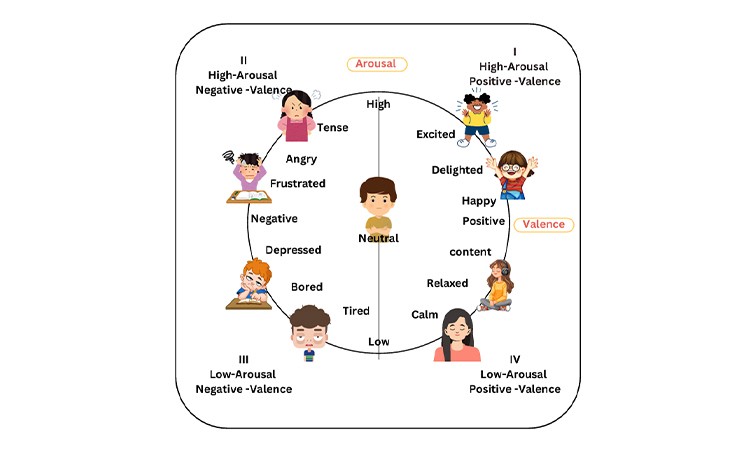
There are different models for this. Some, like Ekman’s model, categorize emotions into a few defined classes (anger, happiness, sadness, etc.). But newer models like the Circumplex Model take a dimensional approach and analyze emotions along the axes of Valence (positive/negative) and Arousal (intensity). This model helps us understand more complex or mixed emotions.
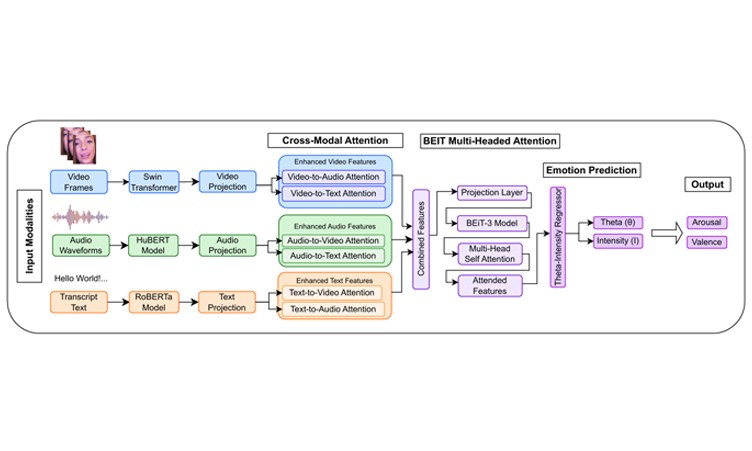
Here’s where things get even more interesting: when data comes from multiple channels, it needs to be combined. Modern architectures such as Transformers (which you might have heard of in ChatGPT or BERT) use a mechanism called Cross-Modal Attention to do this. This means they can detect how someone’s tone changes the meaning of their words, or figure out when someone’s facial expression doesn’t match their voice (for example, when someone says “I’m happy for you” with a forced smile).
Data challenges and ethical realities
One of the biggest challenges in this field is data. The data we have often lacks diversity, doesn’t cover different cultures, and even the emotion labels can be ambiguous. This is where methods like Label Distribution Learning can help, because instead of giving each sample a single definitive label, they consider a probability distribution for different emotions.
But the bigger concern is ethics. When a system can track our emotions, what happens to our privacy? If these systems are used in recruitment or advertising, how can we prevent discrimination or emotional manipulation? And most importantly, can we trust a model that essentially works like a Black Box and we don’t really know why it reached a certain conclusion?
Attractive yet sensitive applications
Affective computing has many applications. From education and intelligent tutoring systems that can detect when a student is tired or confused, to mental health and patient monitoring. Even in smart cars, these systems can detect driver fatigue or anger and take action to prevent accidents.
But just as this technology can be useful, it can also be dangerous. Systems that monitor our emotions can easily turn into tools for constant surveillance or behavioral manipulation. That is why in the research I am doing, one of my top priorities is to understand how this technology can be developed responsibly and ethically.
Where do we want to go?
The main goal of this research for me is to understand how this technology can be used responsibly and ethically. Affective computing can transform the future of human-machine interaction; but without transparency (Explainable AI) and strong legal frameworks, the same technology can become a tool for surveillance, classification, and even manipulation of our emotions.
I think the most important question is: How can we build a machine that is empathetic without undermining our humanity? This is exactly what I am trying to answer in my current research.